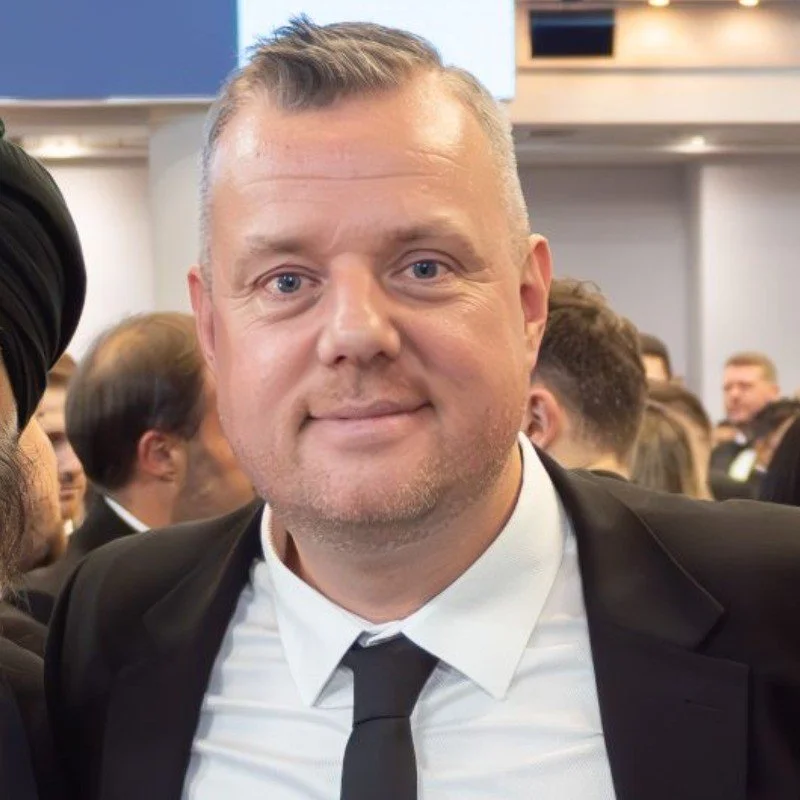
Chris Woods, founder of CyberQ Group, is our guest in this edition of our Founder Spotlight Series.
From growing up in a Birmingham pub to building military-grade cyber capabilities for the Qatari government, Chris brings a wealth of global experience to the cybersecurity space.
After holding senior positions at Fujitsu and Hewlett-Packard, and working with the European Space Agency and GCHQ, he launched CyberQ Group to serve as a pure-play cybersecurity partner for businesses worldwide.
We sat down with him to discuss why cybersecurity is no different than physical security, how his team once hacked a smart kettle to record a board meeting, and why AI is bringing about a "new dawn" of digital threats.
Both questions and answers have been lightly edited for length and clarity.
The Conversation
What is one thing about being a founder that nobody warned you about?
Being a single founder is a lonely job because the buck ultimately stops with you. You need immense resilience because nothing ever goes the way you expect.
The challenges never stop; they just change as you grow from worrying about paying the mortgage in the early days to figuring out how to hit £20 million in revenue today.
There is a Marine quote I love: "Everybody wants to get to heaven, but nobody wants to die," which perfectly encapsulates the hard reality of entrepreneurship.
What is your background in entrepreneurship, and how did you start CyberQ Group?
I grew up in a pub in Birmingham called The Olive Branch.
After university, I spent seven years as a penetration tester at Fujitsu, then moved to HP where I worked on projects for the European Space Agency, APAC, and GCHQ.
After that, I spent five years in Qatar building military-grade cybersecurity capabilities.
When I returned to the UK in 2016, I decided to start my own global business rather than going back to the corporate world.
What is the story behind the name CyberQ Group?
We wanted to focus purely on cyber, not general IT or network management.
The "Q" is inspired by my love for James Bond—specifically the quartermaster who invents lethal pens and innovative gadgets—as well as the demigod "Q" from Star Trek and my time working with GCHQ.
That innovation is core to our group; for example, one of our pen testers once hacked a smart iKettle to access an internal network and record a boardroom meeting via an Android TV.
“The “Q” is inspired by my love for James Bond”
How do you explain cybersecurity to someone outside the industry?
Cybersecurity professionals do a rubbish job of explaining what we do by using confusing buzzwords like "lateral movement" or "port scanning".
It is exactly the same as physical security. If someone breaks into your building, you ask if the windows were locked, if you had a security guard, and if you had CCTV to see their face.
A Security Operations Center is just digital CCTV.
The true measure of a company is not whether they get hacked—most will—but how rapidly they respond to minimize the damage and secure their assets.
“Small businesses forget that their biggest advantage over a billion-pound corporation is that they actually care about the client’s specific problem.”
How is AI changing the cybersecurity landscape?
There are generally four types of threat actors: state-sponsored, organized crime, hacktivists, and insider threats. AI makes all of these attackers incredibly powerful.
An average "script kiddie" can now use AI agents to speed up their attacks and map networks instantly to extract data. However, AI also helps defenders with better contextualization and alert enrichment.
We are entering a "new dawn" of cyber, similar to the early days of the internet when websites were easily and frequently hacked, because threat actors are deploying autonomous AI agents to breach organizations.
How did you get your first customers and hit that first million?
Passion and relationships. Small businesses forget that their biggest advantage over a billion-pound corporation is that they actually care about the client's specific problem.
You lower the risk for new clients by doing a one- or two-week proof-of-concept to show them your work, proving you are better than the giant vendors who only care about hitting quarterly numbers.
Today, we are VC-backed, which gives us immense credibility, but we still lead with that same passion.
Closing thoughts
Chris’s insights reveal that while the technology behind cyber threats is rapidly advancing, the foundational principles of business and security remain deeply human. Key takeaways include:
Analogies Clarify Complexity: Translating technical cyber jargon into everyday physical security concepts (like CCTV and locked doors) builds immediate trust and understanding with clients.
Sell Your Passion: A small startup’s greatest competitive advantage against massive global corporations is genuine care and passion for solving the client's problem.
Response > Prevention: The stigma around being hacked is fading; the true measure of a business's cyber maturity is the speed and effectiveness of its incident response.
AI is a Double-Edged Sword: While generative AI supercharges malicious actors and script kiddies, it equips cybersecurity defenders with equally powerful tools for contextualizing and stopping threats.
Connect With Our Guest
Connect with Chris: LinkedIn